
Deir el-Medina is where the men who carved the royal tombs lived, died and — knowing exactly how it was done — built themselves some of the most beautiful small tombs in Egypt. The workers’ village on Luxor’s West Bank is the necropolis’s human story, and one of its most rewarding quiet stops.
Quick Answer: Deir el-Medina is the excavated village of the artisans who built the tombs in the Valley of the Kings, located in a desert hollow on Luxor’s West Bank. Visitors see the village foundations, a small Ptolemaic temple, and the workers’ own painted tombs — smaller than the royal ones but with color just as vivid.
- Home of the tomb-builders for ~450 years of the New Kingdom.
- The workers’ tombs (Sennedjem, Inherkhau) hold some of Egypt’s freshest painting.
- Thanks to thousands of surviving written fragments, this is the best-documented village of the ancient world.
Table of Contents
The Village That Wrote Everything Down
The tomb-builders were literate — they had to be, copying religious texts onto royal walls — and they wrote constantly on limestone flakes and pottery: laundry lists, love poems, court cases, absences from work (“brewing beer” is a recorded excuse), even history’s first documented labor strike, under Ramses III, over late grain rations. Because of those ostraca, we know these workers by name, family and personality.
What to See
The Workers’ Tombs
The tomb of Sennedjem is tiny — a single vaulted chamber — and stepping into it is like opening a jewel box: the yellows and blues look painted last year. Builders who spent their days on pharaohs’ eternity gave themselves the same care at a domestic scale. A small number of tombs are open in rotation.
The Village and the Temple
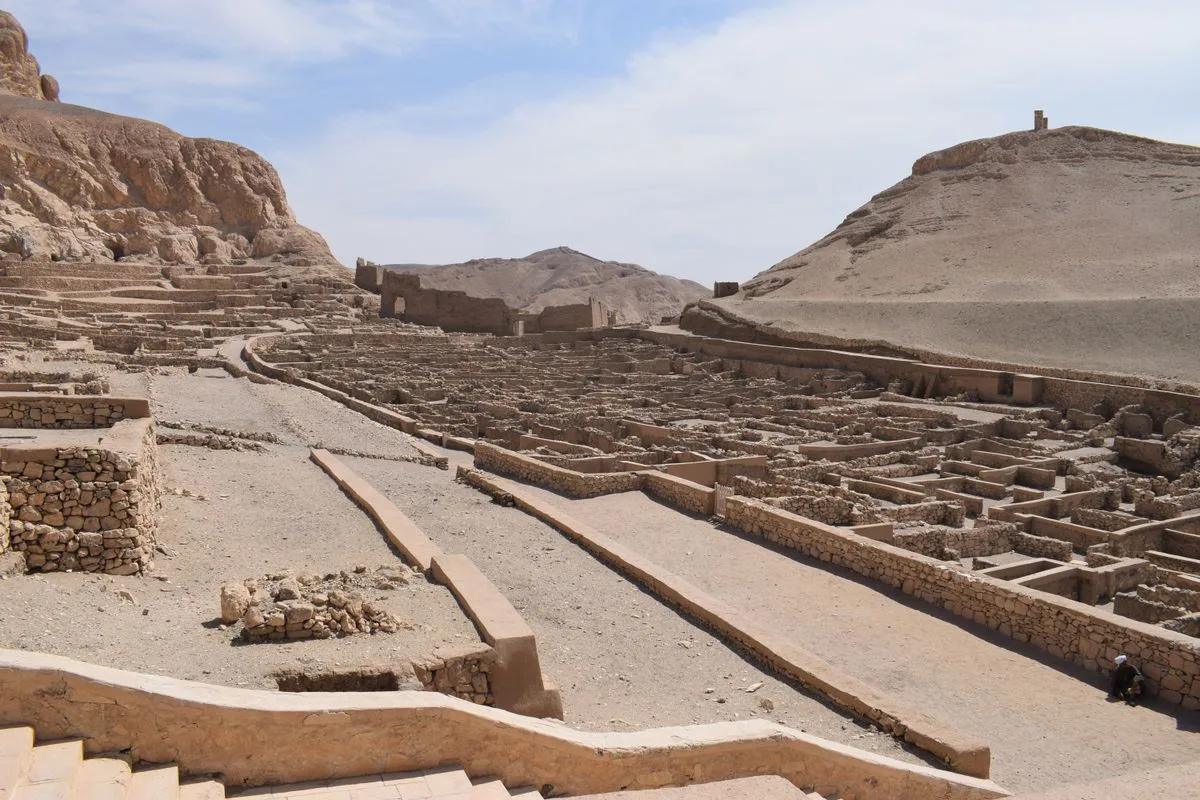
The stone foundations of some 70 houses line a single street in the desert hollow. Above them stands a small, well-preserved Ptolemaic temple to Hathor and Maat, later a Coptic monastery — which gave the site its Arabic name, “Monastery of the Town”.
Visiting Information
| Detail | What to know |
|---|---|
| Location | West Bank hollow between Medinet Habu and the Valley of the Queens |
| Time needed | 45 minutes – 1 hour |
| Crowds | Minimal — you may have the tombs to yourself |
| Combine with | Medinet Habu (5 minutes away) after a Valley of the Kings morning |
How It Completes the West Bank
See the Valley of the Kings first — the product — then Deir el-Medina, the producers. With Medinet Habu next door you have the perfect quiet second act to a West Bank morning; we add both to any private Valley of the Kings tour on request.
Deir el-Medina, the tomb-builders’ village, is part of Ancient Thebes, a UNESCO World Heritage Site. Read the official entry at the UNESCO World Heritage Centre.
FAQs About Deir el-Medina
What was Deir el-Medina?
The purpose-built village of the artisans — “Servants in the Place of Truth” — who cut and decorated the royal tombs of the Valley of the Kings and Queens.
Whose tombs can you enter?
A rotating selection of workers’ tombs, most famously Sennedjem’s and Inherkhau’s, with exceptionally preserved painting.
Why is Deir el-Medina important to historians?
Its thousands of written ostraca document daily life — wages, strikes, lawsuits, family quarrels — making it the ancient world’s best-known community.
Is Deir el-Medina worth it with limited time?
If you have two days in Luxor, yes — it adds the human dimension the royal valley can’t. On a one-day sprint, the classic trio comes first.
Meet the tomb-builders: ask us on WhatsApp to include Deir el-Medina in your West Bank day — and see the full Luxor travel guide for the bigger route.
